
Selecting the correct sluice valve is important for ensuring reliable isolation, minimum leakage and long service life in water-supply systems. Soft-seated and metal-seated sluice valves perform the same basic function, but their construction, sealing characteristics and suitable applications are different.
This guide explains the key differences and helps project engineers, contractors and procurement professionals select the appropriate valve for their application.
What Is a Sluice Valve?
A sluice valve, also known as a gate valve, is primarily used to start or stop the flow of water in a pipeline. It operates by moving a gate or wedge vertically across the flow path.
Sluice valves are normally intended for fully open or fully closed operation. They should generally not be used for continuous flow regulation because partial opening can cause vibration, turbulence and damage to the sealing surfaces.
What Is a Soft-Seated Sluice Valve?
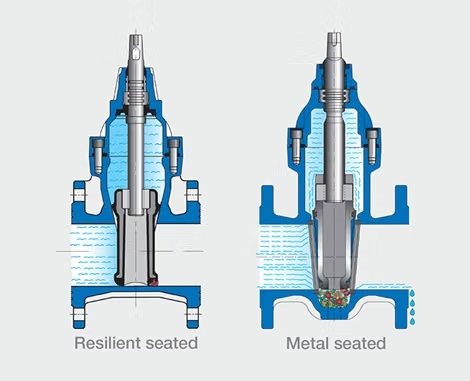
A soft-seated or resilient-seated sluice valve uses an elastomer-covered wedge to create the seal. When the valve closes, the resilient material compresses against the valve body seating area and provides tight shut-off.
These valves are widely used in potable-water distribution, treated-water pipelines, pumping stations and municipal water-supply systems.
Main Advantages of Soft-Seated Valves
- Tight shut-off with very low leakage
- Lower operating torque
- Smooth internal waterway
- Reduced accumulation of sediment in the valve body
- Suitable for frequent operation
- Good corrosion resistance when properly coated
- Generally lower maintenance in clean-water applications
Important Considerations
The elastomer material must be compatible with the conveyed fluid, operating temperature and water-quality requirements. The valve coating, spindle material, fasteners and gearbox must also comply with the approved project specification.
What Is a Metal-Seated Sluice Valve?
A metal-seated sluice valve uses metal sealing surfaces on the gate and body. The sealing arrangement is designed to withstand demanding operating conditions where a resilient sealing material may not be suitable.
Metal-seated valves are commonly considered for raw water, industrial water, higher-temperature service and applications containing limited suspended particles, subject to the project specification and manufacturer’s recommendations.
Main Advantages of Metal-Seated Valves
- Robust construction
- Suitable for demanding operating conditions
- Better suitability for certain higher-temperature services
- Metal sealing surfaces are not dependent on an elastomer seat
- Appropriate for applications where the specified fluid is incompatible with soft sealing material
Important Considerations
Metal-seated valves may require higher operating torque and may not provide the same level of tight shut-off as a properly selected resilient-seated valve. Sediment can also collect in the seating area, affecting closure if the valve design and maintenance practices are unsuitable.
Soft-Seated vs Metal-Seated Sluice Valves
| Selection factor | Soft-seated valve | Metal-seated valve |
|---|---|---|
| Sealing arrangement | Elastomer-covered wedge | Metal-to-metal seating |
| Shut-off performance | Generally provides tight shut-off | Leakage class depends on design and specification |
| Operating torque | Generally lower | Generally higher |
| Waterway | Usually smooth and unobstructed | Seating arrangement may create a body recess |
| Typical service | Potable and treated water | Raw water and demanding industrial applications |
| Sediment sensitivity | Generally lower in a smooth-bore design | Sediment may collect near the seating area |
| Temperature capability | Limited by elastomer selection | Suitable for higher temperatures in appropriate designs |
| Maintenance | Usually lower in clean-water service | Seating surfaces may require periodic attention |
Which Valve Should Be Selected?
For most potable-water and treated-water distribution systems, soft-seated sluice valves are commonly preferred because of their tight shut-off, lower torque and corrosion-protected construction.
A metal-seated sluice valve may be preferred where the operating temperature, fluid characteristics, suspended matter or project specification does not permit resilient seating.
Selection should never be based only on price. The following parameters should be reviewed before ordering:
- Pipeline size and pressure rating
- Maximum working and test pressure
- Type and temperature of the fluid
- Water quality and suspended solids
- Required leakage or shut-off performance
- Buried, chamber or above-ground installation
- Manual, gearbox or actuator operation
- Frequency of operation
- Coating and corrosion-protection requirements
- Face-to-face dimensions and flange standard
- Approved QAP, inspection and testing requirements
- Project specifications and applicable standards
Common Selection and Installation Mistakes
Common problems arise when a valve is ordered without confirming the pipeline pressure, flange drilling, flow medium or installation conditions. Incorrect alignment, inadequate support, excessive flange-bolt tightening and improper actuator settings can also affect valve performance.
Before commissioning, the valve should be inspected for transit damage, operated through its complete travel and installed without transferring pipeline stress to the valve body. Flushing of the pipeline before final operation is also recommended.
Conclusion
Both soft-seated and metal-seated sluice valves have important applications. Soft-seated valves are generally suitable for clean-water systems requiring tight shut-off and low operating torque. Metal-seated valves may be more appropriate for demanding services where the fluid or temperature is unsuitable for elastomeric sealing.
The final selection must be based on the approved technical specification, operating conditions and recommendations of the qualified valve manufacturer.
Need Technical Assistance?
Geetanjali Enterprises supports water-infrastructure contractors and project authorities with the selection and supply of pumps, valves, flow meters, instrumentation and automation systems.
For product selection or project enquiries:
Geetanjali Enterprises
Website: www.geetanjaliente.com
Email: info@geetanjaliente.com
Contact: +91 95348 63658
Disclaimer: This article provides general technical guidance. Final product selection must follow the project specifications, applicable standards, approved drawings and manufacturer’s recommendations.