
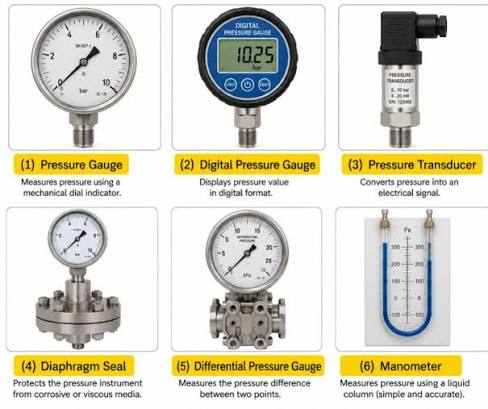
Accurate pressure measurement is essential for the safe and efficient operation of industrial processes. A properly selected pressure transmitter helps operators monitor pipelines, pumps, tanks, filters and process equipment while transmitting reliable measurement data to a PLC, SCADA system or controller.
However, selecting a pressure transmitter only by its measuring range or price can lead to inaccurate readings, premature failure and process interruptions. The process medium, pressure type, accuracy, wetted materials, output signal and installation conditions must all be considered.
What Is a Pressure Transmitter?
A pressure transmitter is an electronic instrument that converts process pressure into a standardized electrical signal. The transmitted signal can be received by a PLC, SCADA system, indicator, controller or data-acquisition system for monitoring and control.
A pressure transmitter generally consists of:
- A pressure-sensing element
- Signal-conditioning electronics
- Process connection
- Wetted components
- Electrical connection or cable entry
- Protective enclosure
Common output signals include 4–20 mA, 0–10 V and digital communication protocols, depending on the selected model and control-system requirements.
Types of Pressure Measurement
The first step is to identify the type of pressure that needs to be measured.
Gauge Pressure
Gauge pressure is measured relative to atmospheric pressure. It is commonly used for pumps, water pipelines, compressed-air systems and many industrial processes.
Absolute Pressure
Absolute pressure is measured relative to a perfect vacuum. It is used where atmospheric-pressure variation must not influence the measurement.
Differential Pressure
A differential-pressure transmitter measures the difference between two pressure points. It can be used for filter monitoring, flow measurement, tank-level measurement and pressure-drop monitoring.
Important Pressure Transmitter Selection Parameters
Measuring Range
The transmitter range should cover the normal operating pressure as well as expected process variations. Selecting an excessively high range can reduce measurement resolution, while selecting a range too close to the operating limit may expose the instrument to overpressure damage.
The following should be confirmed:
- Normal operating pressure
- Minimum and maximum process pressure
- Pump shut-off pressure
- Possible pressure surges
- Required overpressure capability
Accuracy
Required accuracy should be selected according to the application. General utility monitoring may not require the same accuracy as custody, laboratory or critical process-control applications.
Accuracy should not be considered in isolation. Long-term stability, temperature effects, repeatability and installation conditions can also affect measurement performance.
Process Medium
The supplier must know whether the process medium is:
- Potable water
- Raw water
- Wastewater
- Air or gas
- Oil
- Chemical
- Steam
- Corrosive or viscous fluid
The wetted components and sealing materials must be chemically compatible with the process medium.
Wetted-Part Material
Common wetted materials include stainless steel and other application-specific alloys. Material selection depends on the fluid, temperature, concentration and corrosion conditions.
For aggressive or clogging media, a diaphragm seal or special process connection may be required.
Process Temperature
Both process and ambient temperatures must be checked. High-temperature service may require a siphon, impulse line, remote diaphragm seal or other suitable arrangement to protect the transmitter.
Output Signal
The output signal must match the receiving control system. A 4–20 mA signal is widely used because it is suitable for industrial transmission and allows detection of certain wiring or instrument faults.
For smart instrumentation, digital communication may provide additional configuration and diagnostic functions.
Process Connection
The connection size and thread or flange standard must match the process tapping. Common options include threaded, flanged and hygienic process connections.
The exact connection type, size, sealing arrangement and pressure rating should be confirmed before ordering.
Electrical Connection and Enclosure
The installation area determines the required:
- Cable entry
- Connector type
- Ingress-protection rating
- Enclosure material
- Hazardous-area certification
- Earthing arrangement
For outdoor installations, adequate protection against rain, dust, heat, vibration and direct sunlight should be considered.
Common Pressure Transmitter Applications
Pressure transmitters are used in:
- Water-supply and pumping stations
- Water and wastewater treatment plants
- Pump suction and discharge monitoring
- Industrial process pipelines
- Compressed-air systems
- Filter differential-pressure monitoring
- Tank-level measurement
- Boiler and utility systems
- Chemical and pharmaceutical processes
- PLC and SCADA automation systems
Common Selection Mistakes
Pressure transmitter problems frequently result from incomplete application information. Common mistakes include:
- Selecting only on the basis of price
- Choosing the wrong pressure range
- Ignoring pressure surges or water hammer
- Using incompatible wetted materials
- Selecting an incorrect process connection
- Ignoring process temperature
- Failing to specify the required output signal
- Installing the transmitter at an unsuitable location
- Using an ordinary transmitter in a hazardous area
- Failing to provide proper cable shielding and earthing
A complete datasheet should be prepared before requesting a quotation.
Information Required Before Requesting a Quotation
Provide the following information to the pressure transmitter supplier:
- Application and process medium
- Pressure type: gauge, absolute or differential
- Measuring range and unit
- Maximum possible pressure
- Process and ambient temperature
- Required accuracy
- Output signal and power supply
- Process connection
- Wetted-part material
- Electrical connection
- Enclosure-protection requirement
- Hazardous-area classification, if applicable
- Display or local-indication requirement
- Required quantity and delivery schedule
Providing complete data helps the supplier recommend a technically suitable transmitter and reduces the possibility of incorrect selection.
Installation Recommendations
Install the pressure transmitter at a location with minimum excessive vibration and temperature exposure. The process connection and impulse line should be properly supported and free from leakage.
For pump applications, consider pressure pulsations and water hammer. A suitable snubber, pulsation dampener or isolation arrangement may be required depending on the operating conditions.
After installation, verify the wiring, polarity, power supply, measurement range and PLC or SCADA scaling before commissioning.
Conclusion
The correct pressure transmitter must be selected by considering the complete application—not only the pressure range. Process medium, operating pressure, temperature, accuracy, material compatibility, output signal and installation environment all influence performance and service life.
Careful technical evaluation before purchase helps improve measurement reliability, reduce breakdowns and protect the industrial process.
Need Assistance Selecting a Pressure Transmitter?
Geetanjali Enterprises supplies pressure-measurement and process-instrumentation solutions for water infrastructure, utilities and industrial applications. We support customers with technical selection based on their process and control-system requirements.
Geetanjali Enterprises
Website: www.geetanjaliente.com
Email: info@geetanjaliente.com
Contact: +91 95348 63658
Disclaimer: This article provides general technical guidance. Final instrument selection must be based on the process datasheet, operating conditions, applicable standards and manufacturer’s recommendations.